

Lihong Bai (b. 1999, Ordos, Inner Mongolia, China) is a London-based artist working across performance, moving image, installation and painting. Trained in Chinese landscape painting from the age of six before completing her MA at the Royal College of Art, Bai reconceives ShanShui (山水) not as an image of nature but as a contemporary spatial condition shaped by transit systems, borders, migration, capital and institutional power.
Growing up in Inner Mongolia, Bai was influenced by traditions of nomadic life in which movement arose from environmental and material necessity rather than individual choice. In her practice, nomadism is understood not as a romantic ideal but as a mode of survival, a continuous process of adapting to shifting conditions.
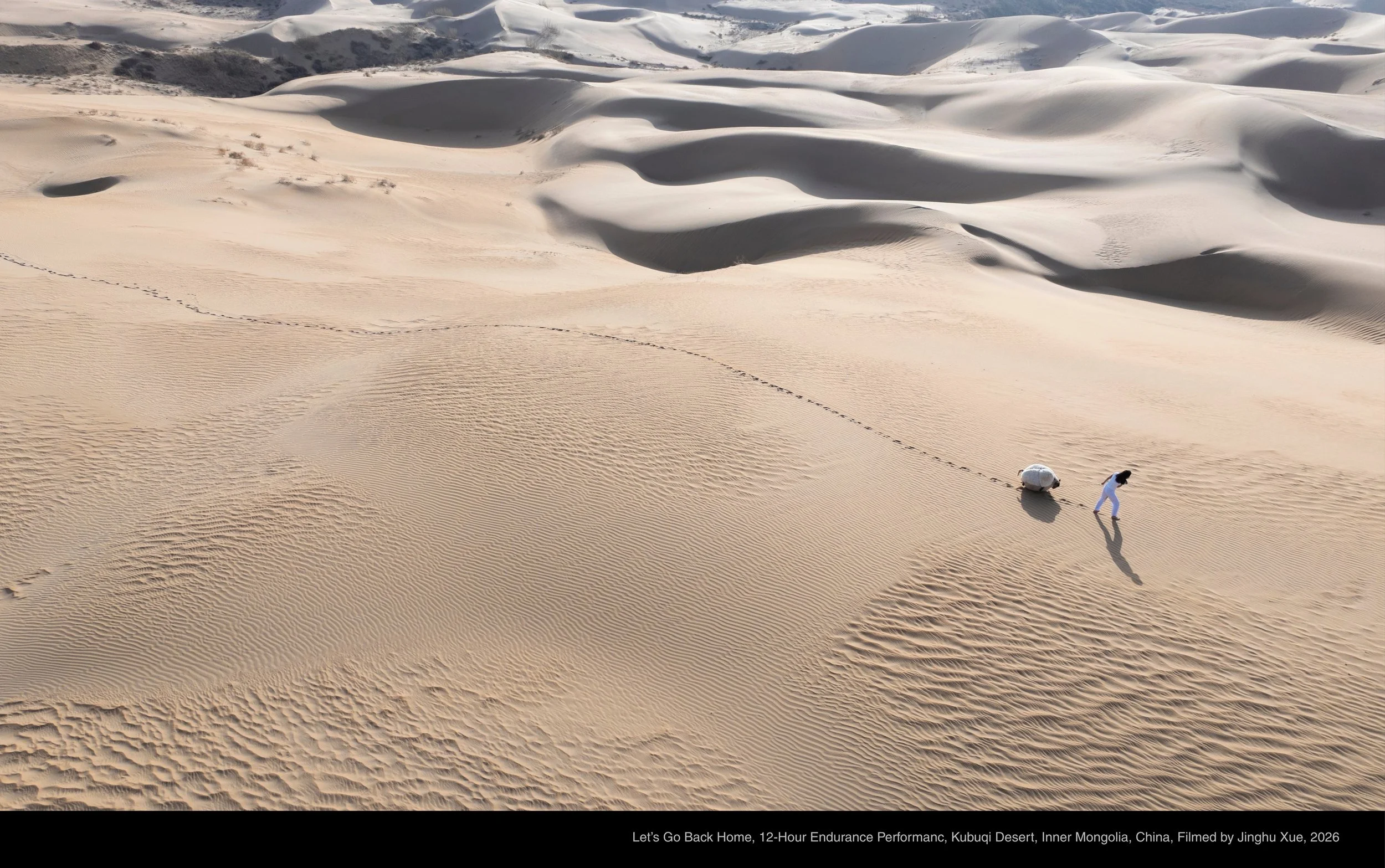
Working across ink, body, architecture and public space, Bai constructs situations in which bodies, materials and environments actively negotiate with one another, whether through eating dry grass in a moving Underground carriage or dragging a sheep through urban space. Her works often begin as live performances before extending into moving image, installation and sculpture, where the body functions simultaneously as material, witness and site. Across her practice, belonging is understood not as a fixed condition but as a continual negotiation between body, territory, institution and power.
Bai received Arts Council England's Global Talent endorsement in 2024. Her work has been presented at the Malta Biennale (2024), Somerset House (2025), the Shanghai International Art Festival (2025), Messums West (2026) and the British Consulate General in Los Angeles (2025). Forthcoming presentations include a solo exhibition at M+M Gallery, Hong Kong, and ART021 Shanghai in late 2026. Her work is held in the permanent collections of the Beijing Contemporary Art Museum and the Museum of East Asian Art, Bath.